
Benchmark overview
HiveBoard evaluates manipulation of mechanisms with constrained motion. A platform may need to rotate a valve about a fixed axis, keep a screw engaged with its thread, align and insert a key, or complete a sequence of dependent actions.
Hardware and platform support
Reproducible hardware
All structural and functional parts are designed for consumer-grade fused-deposition modelling using PLA. The shared press-fit geometry allows laboratories to reproduce the same board without a specialized fixture.
Modular tasks
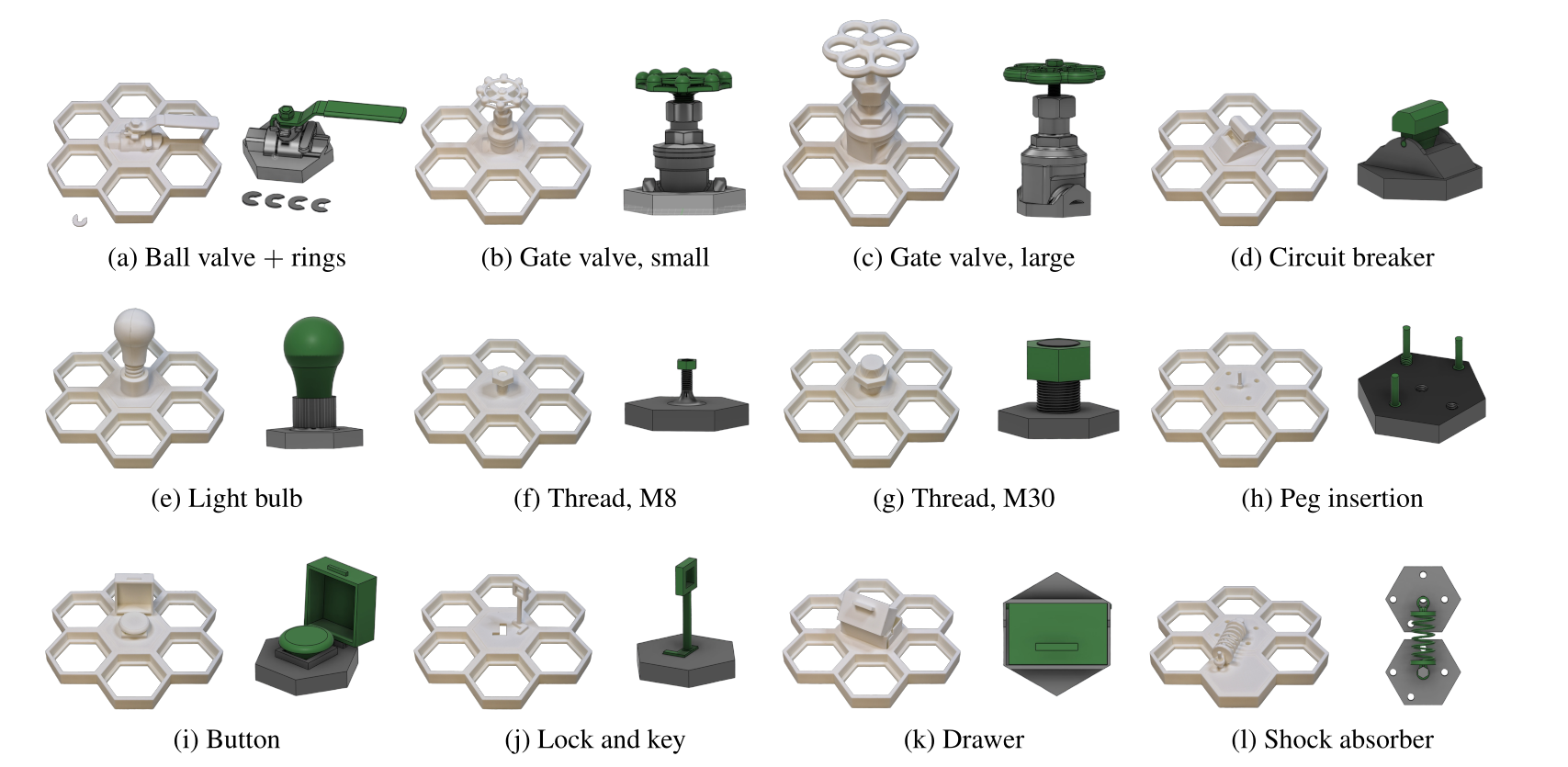
HiveBoard has 12 attachment designs evaluated in 13 conditions. The ball valve is evaluated without and with a friction ring, giving two conditions for the same attachment design.
The seven-cell honeycomb base accepts interchangeable attachments. Attachments can be swapped without changing the base, and new tasks can reuse the same mounting interface.
Embodiment-independent evaluation
The protocol treats a platform as an end-effector plus the system that positions and commands it. This keeps the benchmark applicable to fixed-base manipulators, quadruped manipulators, wearable devices, prosthetic hands, and exoskeletons.
Simulation models
The repository includes articulated assets with visual and collision meshes, joint limits, and nominal physical properties. These assets support inspection and integration in common robotics simulators; a separate repository contains the Isaac Lab implementation.
Task categories
| Category | What it tests | Attachments |
|---|---|---|
| Torque | Rotational manipulation and force transmission | Ball valve; Ball valve + ring; Gate valve (small); Gate valve (large); Circuit breaker |
| Precision | Alignment, threading, insertion, and controlled rotation | Light bulb; Thread (M8); Thread (M30); Peg insertion |
| Composed assembly | Ordered sequences with stage-wise progress | Button; Lock and key; Drawer; Shock absorber |
What the benchmark reports
For each attachment, the protocol records:
- task outcome and completion time;
- attempts and regrasps;
- prehensile or non-prehensile strategy;
- last completed stage for composed assembly tasks; and
- one dominant failure cause for unsuccessful trials.
HiveBoard is intended to characterize task performance and failure modes. The validation protocol does not, by itself, define a universal ranking of platforms or control interfaces.
Repository files
The current files are maintained in the HiveBoard parts and protocol repository:
STL/— printable parts;CAD/— editable source geometry;Simulation/— URDF and USD assets;Documentation/— protocol and trial templates.